
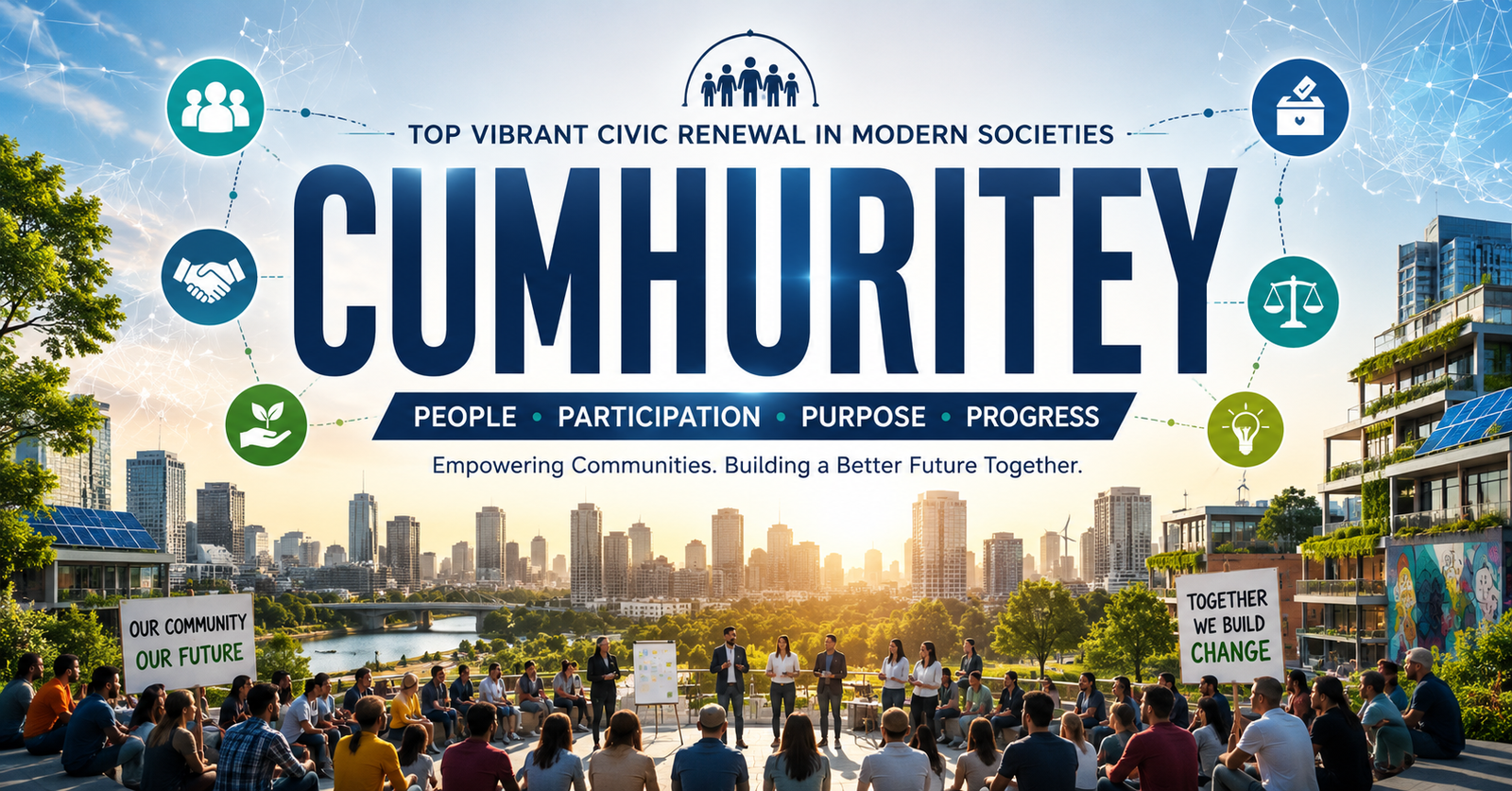
Cumhuritey in today’s fast-changing world, many societies face growing challenges such as political division, social isolation, distrust in institutions, economic inequality, and environmental crises. People across the globe are searching for new ways to rebuild stronger communities and create fairer systems. Out of this growing need for collective progress, a new concept has emerged online and in civic discussions:
Although the word may sound modern and mysterious, it carries deep meanings connected to democracy, civic participation, social responsibility, and community empowerment. Inspired by the Turkish word “Cumhuriyet,” meaning “Republic,” it represents a fresh vision for modern societies where ordinary people actively shape the future together.
Unlike traditional political systems that rely heavily on governments and centralized power, it focuses on shared leadership, local action, inclusion, and cooperation. It encourages people to become participants instead of spectators in the development of their communities.
Today, the idea of it is spreading rapidly across blogs, online discussions, social movements, youth communities, and digital platforms because it speaks directly to the concerns of the modern generation. It combines democratic ideals with innovation, technology, sustainability, and human connection.
In this complete guide, we will explore the meaning of Cumhuritey, its historical roots, key principles, modern relevance, digital influence, global examples, challenges, and why it may become one of the defining civic ideas of the 21st century.
What Is Cumhuritey?
Cumhuritey is a modern civic concept inspired by the idea of collective participation and shared social responsibility. While the term itself is not an official political ideology, it has evolved into a symbolic expression representing:
- Civic renewal
- Participatory democracy
- Community-driven progress
- Inclusive governance
- Social innovation
- Citizen empowerment
- Ethical responsibility
At its core, Cumhuritey promotes the belief that society becomes stronger when citizens actively contribute to public life instead of depending entirely on governments or powerful institutions.
It encourages people to:
- engage in discussions,
- support fairness,
- protect equality,
- and work together for long-term social improvement.
The Origins of Cumhuritey
From “Cumhuriyet” to Cumhuritey
The word it is widely believed to be inspired by the Turkish term “Cumhuriyet,” which translates to “Republic.” Ttoward people’s sovereignty, democratic governance, modernization, and social equality following the fall of the Ottoman Empire.
Over time, digital culture and online discussions appear to have transformed the traditional term into “Cumhuritey,” expanding its meaning beyond politics into a broader social and philosophical concept. Today, it is often interpreted as representing an engaged and empowered society where individuals actively contribute to shaping their communities, influencing collective progress, and participating in decisions that impact the future.
It reflects values such as civic responsibility, collaboration, inclusiveness, and the belief that positive change is driven by active public participation.he concept gained historical significance with the establishment of modern Turkey in 1923, symbolizing a shift
Historical Background of Civic Renewal
Key Points About the Historical Foundations of Cumhuritey
Historical Roots of Civic Participation
The principles behind it are inspired by historical systems of public participation and collective decision-making.
Ancient Greek assemblies allowed citizens to engage directly in political discussions and governance.
Roman republican systems emphasized representation, civic responsibility, and public involvement.
Community-Based Governance Traditions
Local councils and community gatherings have long served as platforms for solving shared challenges.
Public town hall meetings encouraged open dialogue and community-driven decision-making.
These traditions helped strengthen civic engagement and social cooperation.
Modern Challenges Facing Society
Today’s world faces complex issues that historical systems never encountered on a global scale.
Challenges include digital misinformation, climate change, economic inequality, globalization, and political polarization.
These issues require new approaches to public participation and collective problem-solving.
Cumhuritey as a Modern Response
Cumhuritey represents a contemporary vision of civic renewal and active citizenship.
It promotes collaboration, community engagement, and shared responsibility in addressing modern challenges.
The concept encourages people to participate in shaping a more informed, inclusive, and sustainable future.
| Principle / Topic | Explanation | Real-World Impact |
| Participatory Democracy | Citizens actively engage in public discussions, policy development, and community decision-making processes. | Creates stronger democratic institutions and improves public representation. |
| Inclusivity | Every individual and social group deserves equal opportunities, representation, and a voice in society. | Promotes social harmony, fairness, and reduces discrimination. |
| Shared Responsibility | Communities work collectively to address social, economic, and civic challenges. | Strengthens cooperation and builds more resilient communities. |
| Transparency | Governments, organizations, and institutions operate openly and provide clear access to information. | Increases public trust, accountability, and confidence in leadership. |
| Sustainability | Decisions prioritize long-term environmental protection, social well-being, and economic stability. | Supports healthier, more stable, and future-focused societies. |
| Local Empowerment | Communities are encouraged to make decisions based on their unique needs and priorities. | Leads to faster problem-solving and community-driven development. |
| Digital Communication | Online platforms enable people to share ideas, organize initiatives, and collaborate efficiently. | Accelerates civic engagement, awareness, and public participation. |
| Technology-Driven Transparency | Digital tools allow citizens to monitor public projects, budgets, and government activities. | Reduces corruption and strengthens institutional accountability. |
| Accessible Civic Participation | Digital platforms make it easier for people to participate in social and civic activities. | Increases public involvement and encourages broader community engagement. |
| Civic Education | Online resources help citizens understand their rights, responsibilities, and governance systems. | Creates better-informed, empowered, and active citizens. |
| Atatürk’s Vision | Emphasized modernization, equality, secular governance, education, and active citizenship. | Helped establish modern republican values and strengthen civic identity. |
| Growth of Cumhuritey | Rising interest in community involvement, collaboration, and meaningful social participation. | Fuels civic renewal movements and encourages positive social change. |
Challenges Facing Digital Civic Movements
Key Challenges Facing Cumhuritey
Misinformation and Fake News
- False or misleading information can spread rapidly across digital platforms.
- Misinformation has the potential to distort public understanding and influence decision-making.
- Promoting media literacy and fact-checking is essential for healthy civic participation.
Online Polarization
- Digital spaces can sometimes deepen social and political divisions rather than encourage constructive dialogue.
- Echo chambers and algorithm-driven content may limit exposure to diverse viewpoints.
- Cumhuritey encourages respectful discussion, collaboration, and mutual understanding.
Digital Inequality
- Not everyone has equal access to the internet, technology, or digital education.
- This gap can exclude certain communities from participating fully in civic life.
- Expanding digital access and literacy is crucial for inclusive participation.
Activist Burnout
- Continuous online engagement can lead to stress, fatigue, and emotional exhaustion.
- Sustainable civic involvement requires balancing activism with personal well-being.
- Long-term social change depends on healthy and resilient participants.
The Role of Youth in Cumhuritey
Technology-Driven Engagement
- Millennials and Generation Z are at the forefront of digital civic participation.
- Their familiarity with technology allows them to organize, communicate, and mobilize effectively.
- Digital tools help young people amplify their voices and influence public conversations.
Commitment to Inclusion and Equality
- Younger generations often prioritize diversity, fairness, and equal opportunities.
- They actively support initiatives that promote social justice and community development.
- Their values align closely with the core principles of Cumhuritey.
Driving Meaningful Social Change
- Youth-led movements frequently focus on climate action, education reform, mental health awareness, anti-corruption efforts, and community empowerment.
- Their innovation, creativity, and energy help generate fresh solutions to modern challenges.
- Young people play a critical role in shaping a more inclusive, informed, and future-focused society.
Building the Future of Civic Participation
- The continued growth of it depends heavily on youth engagement and leadership.
- By combining technology with civic responsibility, younger generations are redefining how communities participate in social progress.
- Their involvement ensures that it remains dynamic, adaptive, and relevant in a rapidly changing world.
Local Communities: The Heart of Cumhuritey
Although it connects to global ideas, real change often begins locally.
Community-level participation includes:
- neighborhood meetings,
- volunteer networks,
- local sustainability projects,
- mutual aid groups,
- and public education programs.
These local efforts build stronger trust between people and create resilient communities.
Global Examples of Cumhuritey in Action
Global Examples of Cumhuritey
Initiatives such as Barcelona’s Decidim platform, Brazil’s participatory budgeting, Iceland’s crowdsourced constitution, and youth innovation hubs in Pakistan demonstrate how citizens can actively contribute to public decision-making and civic development.
These examples show that Cumhuritey is a global concept, transcending national and cultural boundaries through community participation and digital engagement.
They highlight the growing role of technology, collaboration, and citizen involvement in shaping more responsive and inclusive societies.
Cumhuritey and Social Equality
Cumhuritey promotes fairness, inclusion, and equal opportunities for all members of society.
It supports key principles such as gender equality, racial justice, disability rights, and economic empowerment.
The movement recognizes that a healthy democracy depends on ensuring that no community is excluded from civic participation and decision-making.
Empowering Marginalized Voices
Cumhuritey encourages societies to actively include underrepresented communities.
This means:
listening to marginalized groups,
creating accessible spaces,
and designing policies collaboratively.
Instead of speaking for communities, it promotes working with them directly.
Sustainability and Cumhuritey
Environmental responsibility is deeply connected to modern civic renewal.
Cumhuritey encourages:
- renewable energy projects,
- community gardens,
- recycling programs,
- sustainable transportation,
- and climate education.
Rather than treating climate problems as distant issues, it promotes local action and long-term responsibility.
Cumhuritey vs Populism
Although Cumhuritey supports people-centered participation, it differs greatly from populism.
Populism Often:
- divides society,
- creates enemies,
- and promotes emotional reactions.
Cumhuritey Focuses On:
- cooperation,
- empathy,
- dialogue,
- and inclusive solutions.
Its goal is not conflict, but collective improvement.
Education: The Foundation of Cumhuritey
Strong civic participation depends heavily on education, making civic literacy, media literacy, critical thinking, and public discussion skills essential components of the it philosophy. When citizens understand their rights, responsibilities, laws, and the systems that govern society, they become more informed, confident, and effective participants in democratic processes. Education empowers individuals to evaluate information critically, engage in constructive dialogue, and make decisions that benefit both their communities and society as a whole. Culture also plays a vital role in it , as art, media, literature, and creative expression help communicate ideas, inspire social awareness, and encourage public engagement. Through storytelling, music, visual arts, and digital content, cultural expression can unite communities, promote understanding, and give people a voice in shaping the values and future of their society.
- humanize public issues,
- inspire emotional connection,
- and encourage dialogue.
Street art, documentaries, music, writing, podcasts, and digital storytelling all help spread civic awareness and social understanding.
How to Practice Cumhuritey in Everyday Life
Anyone can support the values of it through simple actions:
- Join local discussions
- Support community projects
- Stay informed about civic issues
- Volunteer in local organizations
- Encourage respectful dialogue
- Promote inclusion and fairness
- Help educate others
Small actions often create large long-term change.
The Future of Cumhuritey in an AI-Driven World
Artificial intelligence is rapidly reshaping modern society.
Cumhuritey encourages ethical AI use through:
- transparent systems,
- citizen oversight,
- digital literacy,
- and protection against algorithmic bias.
Instead of replacing human participation, technology should strengthen it.
The future of civic renewal will likely depend on balancing:
- innovation,
- democracy,
- and human values.
Conclusion
Cumhuritey is far more than a trending internet term—it represents a powerful and evolving vision for civic participation, collective responsibility, social equality, and democratic renewal.
Inspired by the republican ideals associated with “Cumhuriyet,” the concept has grown into a modern philosophy that encourages communities to work together, strengthen public trust, and empower ordinary citizens to play an active role in shaping society.
In an era marked by political polarization, economic uncertainty, misinformation, and rapid technological change, it offers a hopeful and practical framework for creating stronger, more connected communities. Its core message is both simple and impactful: meaningful progress is achieved not through isolated efforts or institutions alone, but through collaboration, empathy, inclusion, and shared purpose.
As people around the world increasingly seek greater participation, transparency, and social fairness, Cumhuritey has the potential to emerge as one of the defining civic ideas of the modern age, inspiring positive change and a renewed sense of community responsibility.
 Ramish