
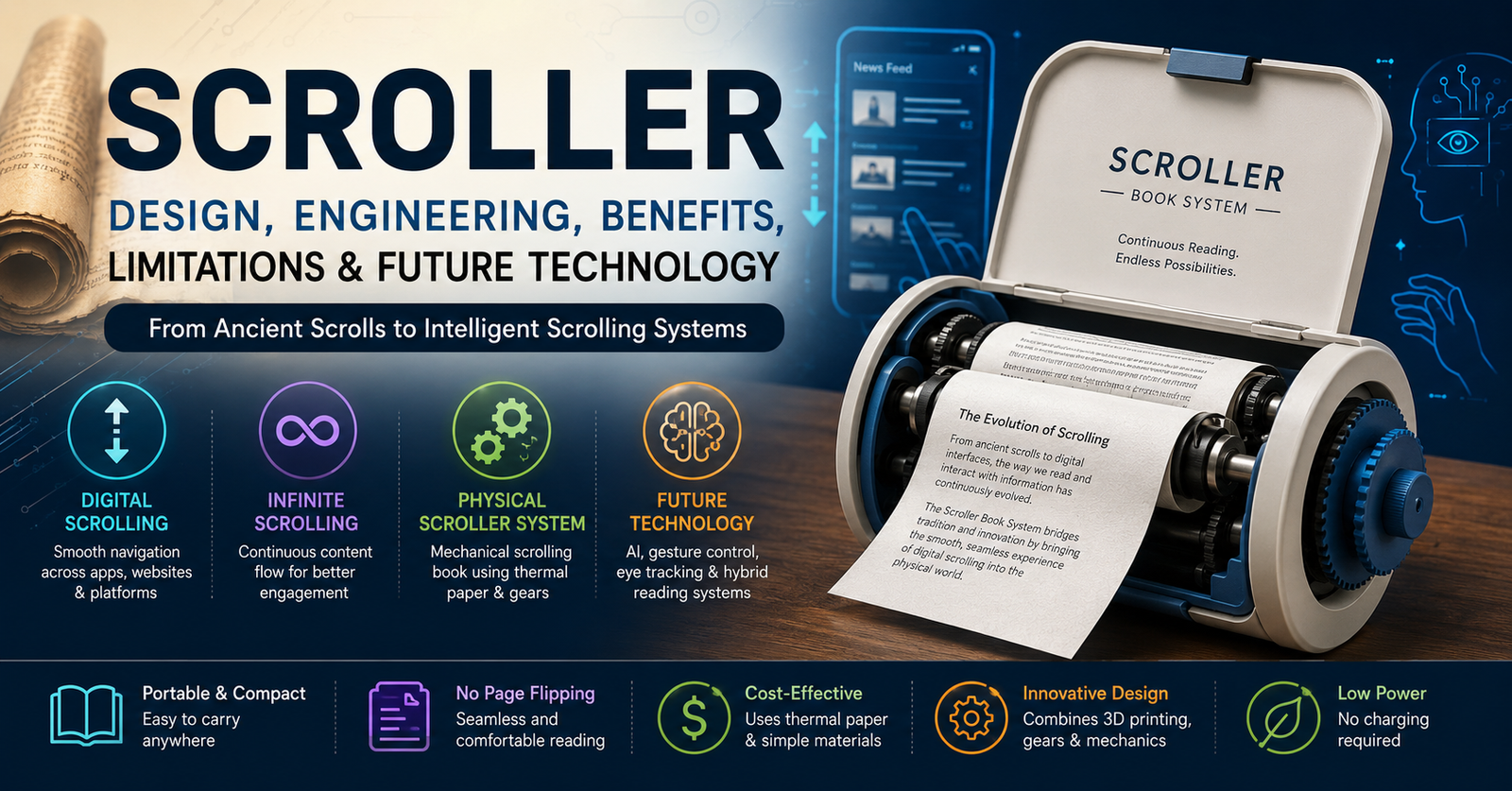
Scroller is a term widely used in modern language and technology to describe the movement through digital content on screens, including websites, mobile applications, and social media platforms. In today’s digital world, it represents both the action and the interface that allows users to navigate information smoothly by moving up, down, or sideways. Beyond technology, the concept of scroller also has historical roots connected to ancient scrolls, where written knowledge was preserved on rolled parchment or paper.
Over time, this traditional method of reading and navigating text has evolved into today’s digital scrolling experience. As a result, Scroller represents both a modern navigation tool and a concept that reflects the long evolution of how humans interact with written information.
What is a Scroller?
A scroller is generally understood as a system, action, or tool that enables continuous movement through content in a structured and convenient way. From a digital perspective, it refers to the ability to move up, down, or sideways across information displayed on screens, a feature commonly used in websites, mobile applications, social media platforms, and various software interfaces.
In a broader or conceptual sense, it can also relate to a continuous format of reading or displaying information, similar to traditional scroll-based systems used in earlier writing practices. In everyday use, scrolling has become a natural user behavior, especially when browsing news feeds, watching videos, reading articles, or exploring social media timelines, making it an essential part of modern digital interaction.
Historical Origin of the Scroller
The word scroll has a rich linguistic history that dates back to medieval Europe, where it originally referred to a rolled piece of parchment or manuscript used for writing and preserving important information. The term is believed to have evolved from the Old French word escroe or escroue, meaning a strip or roll of paper, which later entered the English language during the Middle Ages.
In ancient civilizations such as Egypt, Greece, and Rome, scrolls were one of the earliest forms of recorded communication and were widely used for literature, religious texts, laws, and historical records.
Old French Roots
The origin of the word “scroll” can be traced to the Old French term “escroe,” which referred to a strip of parchment, a rolled document, or an official administrative record. In early societies, this term was widely connected to written communication, record-keeping, and the preservation of important information. These scrolls played a major role in legal, religious, and governmental documentation long before the invention of modern books and digital systems.
Middle English Development
After the Norman Conquest in 1066, many French words became part of the English language, including the term escroe Over time it evolved into Middle English forms such as scrowe and scrouwe which were commonly used to describe rolled manuscripts, official records, and written documents. These terms reflected the importance of handwritten communication and document preservation in medieval society.
Modern English Evolution
Over time, the word evolved into the modern English term “scroll.” Its meaning gradually expanded from a physical rolled document to a broader concept of continuous movement through content, especially in digital environments.
Evolution into Digital Scrolling
The concept of scrolling transformed significantly with the rise of computers and the internet, changing from a physical method of reading documents into a digital navigation tool. As websites, software, and online platforms began displaying large amounts of information on screens, scrolling became essential for moving through content quickly and efficiently. With the introduction of computer mice, touchpads, smartphones, and touchscreen devices, scrolling evolved into a smooth and interactive user experience.
From Paper to Screen
In ancient civilizations, important information was recorded on parchment scrolls that had to be physically unrolled for reading. This traditional method of accessing written content later inspired the modern digital concept of scrolling. In today’s digital world, users move through continuous streams of information on screens without turning pages, creating a faster and more seamless reading experience across websites, applications, and online platforms.
Birth of Scrolling in Technology
Scrolling became an essential part of digital interaction with the introduction of mouse wheel navigation, keyboard arrow controls, and touchscreen swipe gestures. These technologies made it easier for users to move through digital content quickly and smoothly across computers, smartphones, and tablets. Later, social media platforms popularized infinite scrolling, a system where new content automatically loads as users continue moving down the screen, creating a continuous and highly interactive browsing experience.
Modern Usage of Scroller
Today, scrolling is essential in almost all digital platforms, including:
- Websites
- Mobile apps
- Social networks
- Online reading platforms
It allows users to interact with large amounts of content in a smooth and efficient way.
Scroller as a Digital Interaction Tool
Vertical Scrolling
The most common scrolling method used in digital interfaces.Allows users to move content up and down on a screen.Commonly used in blogs, articles, news websites, and social media feeds.
Horizontal Scrolling
Enables side-to-side movement of content.Often used for image galleries, product sliders, and content carousels.Helps display multiple items within limited screen space.
Infinite Scrolling
Automatically loads new content as the user continues scrolling.Popular on platforms such as Facebook, Instagram, and TikTok.Designed to increase user engagement and continuous browsing.
Smooth Scrolling Systems
Uses fluid animations to create a more natural scrolling experience.Reduces sudden jumps between sections of content.Improves visual appeal, navigation comfort, and overall user experience.
The Scroller Book System
- The Book System converts traditional books into a continuous scroll format
- It replaces page-turning with a smooth rolling motion similar to digital scrolling
- The idea combines ancient scroll reading methods with modern mechanical and digital design concepts
- The system uses continuous thermal paper to print content in one long strip
- Paper is loaded into a dual-cylinder mechanism for movement control
- A scrolling wheel moves the paper forward while one cylinder unrolls it and the other collects it
- This creates a seamless reading experience without page breaks
- Key components include 80mm thermal printer paper for continuous output
- A 3D-printed body structure is used to hold and support the system
- Bearings and gears ensure smooth rotation and movement
- Paper rollers control the flow and tension of the scrolling material
Design & Engineering Concept
The Scroller system is not just a reading idea but also a combination of mechanical design and functional engineering. It merges traditional printing methods with modern 3D design techniques to create a continuous reading experience.
Structure Design
The physical structure of the Scroller is designed to be compact, comfortable, and highly functional, featuring a rounded body that provides an easy and ergonomic grip for users. It includes a lid system that allows simple loading and removal of the scroll, making the device user-friendly. Inside the structure, an internal gear mechanism carefully controls the movement of the paper, ensuring smooth and consistent scrolling. Overall, the design balances portability with efficient continuous scrolling performance.
Mechanical System
The mechanical system is the core of the Scroller device.
- One cylinder is responsible for feeding the printed paper forward.
- The second cylinder collects the rolled-up content as it moves.
- A gear-driven scrolling wheel connects both cylinders and controls smooth movement.
This system allows the reading material to move continuously without manual page flipping, creating a smooth reading experience.
Materials Used
The Scroller system is constructed using simple and widely available materials such as PLA filament for 3D printing the main body structure, bearings to ensure smooth rotation, and thermal paper for continuous text printing. Depending on the design, basic electronics or additional tools may also be included for improvements and functionality. These accessible materials make the system cost-effective and suitable for experimental and prototype development.
Limitations & Challenges
Despite its innovation, the Scroller system also faces several limitations:
- Limited durability of thermal paper, which may fade over time
- Not widely adopted yet, making it more of a prototype concept
- Requires technical setup, including 3D printing and mechanical assembly
- Not suitable for mass publishing, due to production complexity
These challenges currently restrict its use to experimental or niche applications.
Comparison: Digital Scroller vs Physical Scroller
| Aspect | Digital Scroller | Physical Scroller System |
| Type | Used in apps, websites, and software interfaces | A mechanical reading device |
| Nature | Entirely software-based interaction system | Based on hardware components and physical movement |
| Accessibility | Instant global access through smartphones and computers | Still experimental and used in niche or DIY projects |
| Function | Enables smooth navigation through digital content | Uses mechanical scrolling to move printed content |
| Core Idea | Continuous content flow in digital environment | Continuous content flow in physical form |
| Key Difference | Operates through digital interfaces | Operates through physical mechanisms |
Future of Scrolling Technology
Scrolling technology continues to evolve rapidly with advancements in digital systems and artificial intelligence, leading to more intelligent and interactive ways of navigating content. In the future, smart scrolling systems may adapt automatically to user behavior, while AI-based navigation could predict what content a user wants to view next.
Emerging technologies like gesture control and eye tracking may also enable hands-free scrolling, making interaction more natural and efficient. Additionally, hybrid systems that combine physical and digital reading experiences could further transform how people access and engage with information in both virtual and real-world environments.
Benefits of Scroller System
The concept offers several practical advantages for readers and designers:
- Portable reading experience in a compact device
- No page flipping required, improving reading flow
- Low cost printing method using thermal paper
- Continuous reading format without interruptions
- No charging required, unlike digital devices
These benefits make it an interesting alternative to both traditional books and digital reading devices.
Conclusion
The concept of Scroller represents a powerful connection between history, language, and modern technology. From its early roots in ancient scrolls to its role in today’s digital interfaces, scrolling has continuously evolved with human communication needs.
At the same time, experimental physical scroller systems show how traditional ideas can be reimagined using modern engineering and design. Together, both digital and physical interpretations highlight the future potential of scrolling as a core part of user experience and information access.
 Hamid
Hamid  Ramish